A few years ago, I went through a feverish phase of bead collecting. I still occasionally fall for a juicy string of vintage beads, but the most virulent stage of the madness seems to have passed. My love of beads derives from my predilection for all things miniature. To me, a bead is a sculpture writ small, and a string of beads is a gallery.

A string of rare Venetian beads that was recently posted on Ebay at $5,000. Seems a bit pricey, but collectors go nuts for these. I should know.
In this post, I’ll share some photos of my vintage Venetian glass beads. They have been making glass in Murano, a tiny archipelago in the lagoon of Venice, since the thirteenth century. Venetian beads were used as trade goods all over the world and were especially prized by indigenous peoples in Africa and the Americas.

A view of Murano, from Wikipedia. Click for source.
Venetian “fancy” lampworked beads are famed for their intricate decoration. These yellow floral beads were cut from a long cane of glass, and each one was individually decorated with green leaves and blue flowers. The “chevron” beads are the most renowned Venetian type. They are made by forming canes of glass from six layers of alternating red, white and blue. Then the canes are cut into segments, and the surface of each bead is ground down to reveal the layers.

Yellow fancies and chevrons. Larger chevron beads are highly prized; these are about an inch long. The beads date to the late 19th or early 20th century. Photo by Linnet.
Thin slices of chevron or other patterned canes can be cut and applied to a solid-colored bead. This is the “millefiori” (thousand flower) technique.
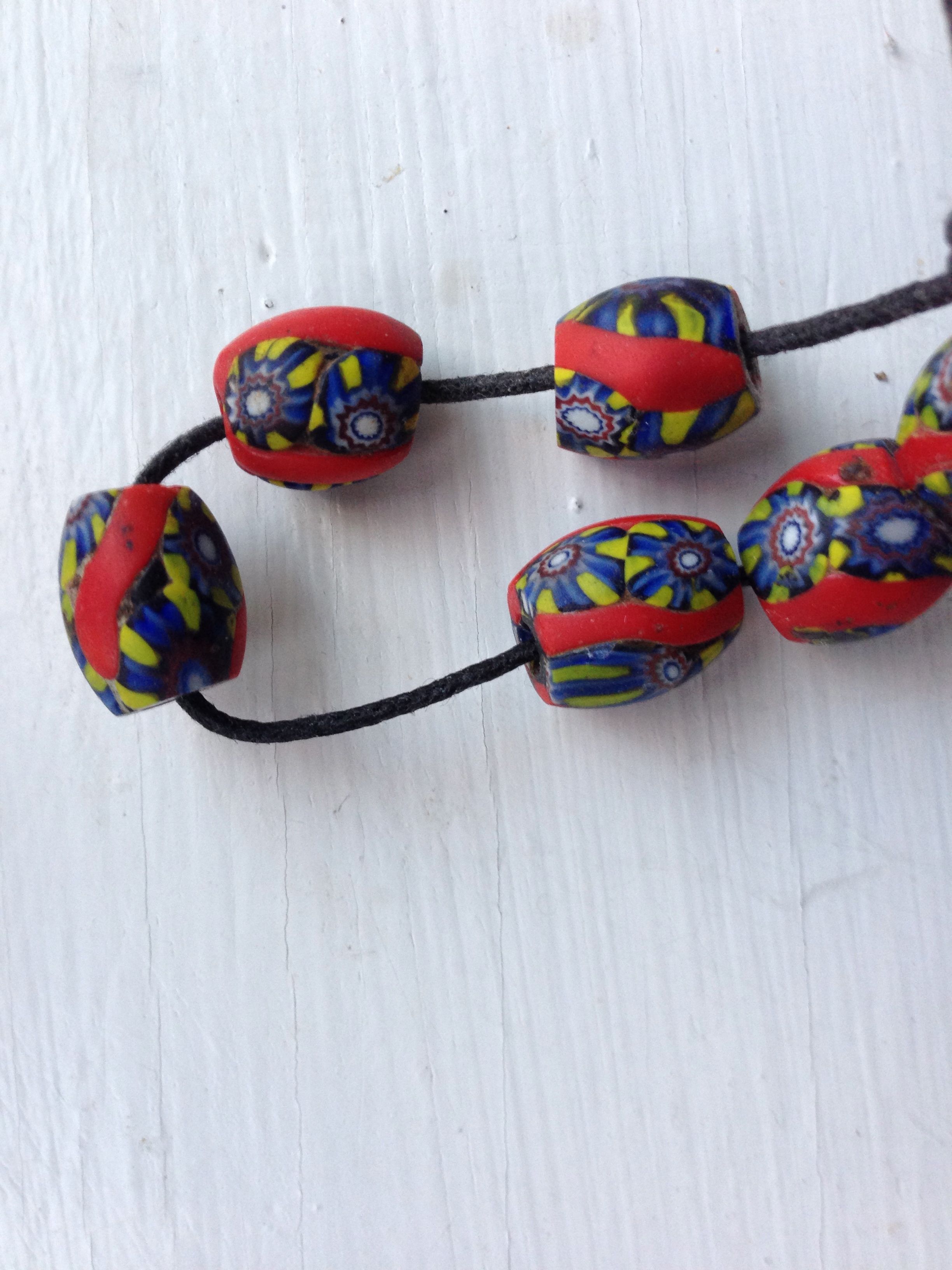
Multi-colored chevron slices were used to make these newer Venetian beads.
Glass hobbyists use millefiori cane slices like these for paperweights, mosaics, and other decorative items. The same techniques are used in candy-making! They definitely look good enough to eat.
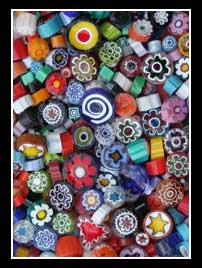
Cane slices from Murano Millefiori, an online shop. Click for their site.
These beads were traded in Africa, perhaps for palm oil or (sadly) ivory. The green bi-cone beads are known as “King beads” because legend has it that they were worn by kings. Such beads were passed down through generations. Indigenously produced glass beads, like those made by Kiffa women in Mauritania, are also highly collectible.
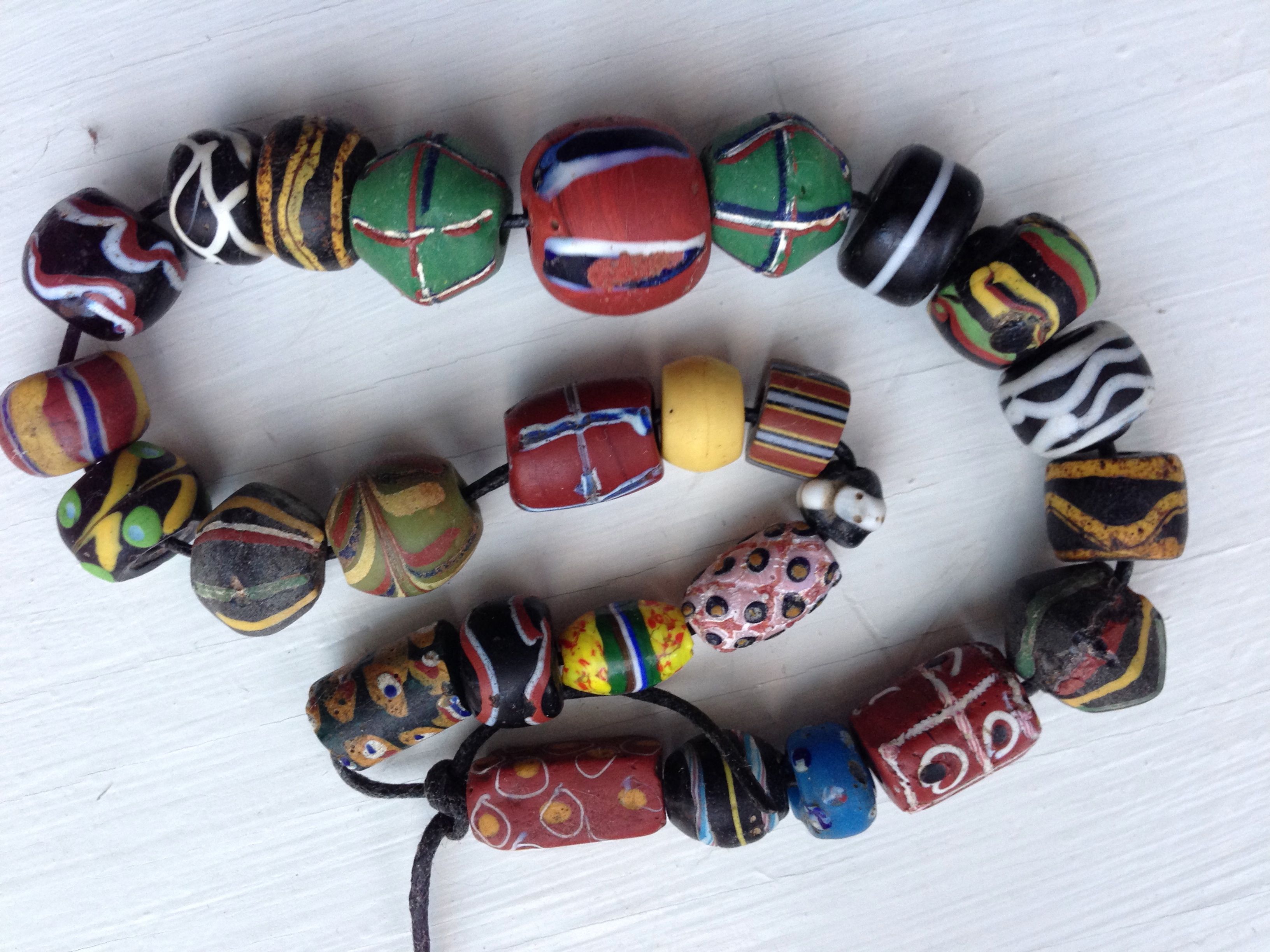
A mix of Venetian fancy beads, each one unique.
These red “eye” beads were individually wound on a stick or “mandrel” before being decorated with white dots. The core is white or yellow, with a red overlay. Older examples used gold oxide to achieve the deep ruby red color, while newer examples used less-expensive selenium and are a brighter china red. This type of bead is known as Cornaline d’Aleppo (Agate of Aleppo). The color and shape variations show that the strand has been assembled from beads of different ages.

Eye beads made in Venice and traded abroad. Photo by Linnet.
This mixed strand includes chevrons of different colors, a black eye bead, and various floral and trailed beads. Click on the photo to enlarge and you will see three Cornaline d’Aleppo beads with fancy “eyes.” Light shining through the uppermost one shows the white inner core.

The tactile and visual appeal of these beads is enormous. I never get tired of looking at them!
In case you’re wondering whether I make jewelry from my beads, the answer is yes! I’ll save that for another post. But with such colorful beads, it’s hard to know what to wear. The beads definitely take over the outfit.
 Linnet Moss
I love beads! Used to trail the bead shops in London…
Can’t wait to see some of your creations 🙂
Many thanks! Beads are so terribly addictive that I always fear I’m going to fall off the wagon and start blowing big bucks on them again. I once bought a string of gemstones for a friend. When I presented it to her, she said, “this is pretty, but what do I do with it?” I hadn’t made the beads into anything wearable. I just thought they were objects of beauty in and of themselves. It reminded me of another friend who loves knitting. She has an entire room filled with giant balls of yarn, enough to last three lives of knitting…
I do get that… the strings are often so beautiful in themselves that you don’t want to destroy their perfect alignment 😉
I’ve usually bought mine with the end-product in mind. I find beadin, as in making necklaces, etc, quite therapeutic.
Me too! But my advancing presbyopia is making it more difficult. I had my eyes fixed some years ago, yet I find myself in glasses most of the time…
There was a wonderful bead store in my neighborhood ( since closed) for crafters and jewelers who made their own art jewelry. I was not among them, but I frequently went in just to salivate over the some of their offerings. The glass and ceramic were gorgeous, but also some of the metal work was beautiful and intricate. It was, as you say, like browsing in a penny candystore.
Yes! I wish I could buy them at penny-candy prices… though I’d probably have to rent a storage garage in which to keep them…
I have the same reaction in a bead store as I do in a book store…a moment of data overload where I just freeze for a minute in the face of all the goodness.
I am on the cusp of succumbing to beads…I’m taking this as a cautionary tale 🙂
Very wise!
I’ve spent way too many hours on the island of Murano and have found myself lost in the maze of incredible art and skill. The beads are gorgeous – and yes, mouthwatering too.
I used to buy my children boxes of beads to make art projects with, but grew tired of the fact that the dog always had a guilty expression on his face soon to be followed by a bout of indigestion.
Look forward to the follow up blog, Linnet. I hope you wear them often!
That is priceless about the dog! He must have found them tasty, if indigestible 😉
Hi, I recently wrote the history of Murano glass beads. Check it out and see if might interest you:
http://www.stravagante-jewelry.com/murano-glass-jewelry-beads-history.html
Marco Piazzalunga
— writer and historian of Murano glass —
Thanks, Marco, for this link to a fascinating piece of scholarship!
Oh my goodness! Amazing article dude! Many thanks,
However I am experiencing issues with your RSS. I don’t know why I cannot join it.
Is there anybody having similar RSS problems? Anyone who knows
the answer can you kindly respond? Thanks!!
Thanks, afraid I know nothing about RSS.
Pingback: Beaded Necklaces 1: “Russian Blue” Beads | Linnet Moss